Why HOWREY?
Howrey consists of three premier practices: Antitrust, Intellectual Property and complex Commercial Litigation and Arbitration. This extraordinary focus has assembled, in one firm, the most effective, efficient and comprehensive advocacy capability and resources available anywhere.
Globally, our clients engage Howrey because of the unparalleled depth and breadth of our trial experience. Our reputation is one of addressing and resolving the most difficult and complex disputes with an unyielding commitment to client service, and by meeting and exceeding our clients’ business objectives for success.
Howrey’s affiliated team of trial-tested attorneys, economists, accountants, scientists and engineers, litigation technologists and jury consultants are available to collaborate and deliver critical expertise to any initiative, issue, investigation or dispute.
Practice Areas Overview
Howrey LLP, a global law firm, provides clients with innovative legal and business solutions to their high-stakes challenges by focusing on complex litigation, antitrust and intellectual property. Ranked among the top law firms by clients in its three areas of focus, Howrey leverages its strategic affiliates, CapAnalysis and Maxiam, to offer a powerful advantage to clients.
Howrey’s Intellectual Property (IP) practice is one of the largest and most renowned IP practices in the world. We are consistently regarded as one of the top go-to firms to handle IP matters in the U.S. and around the globe. With more than 200 IP professionals, including attorneys, patent agents and scientific advisors, Howrey has the depth and breadth of legal and technical expertise to provide IP services of the highest quality.
Download Free Power of Attorney Forms
Howrey’s legal database includes an extensive list of free legal templates to help you secure the relevant legal issues daily. But do take a minute and review the definitions and guidelines that may assist you in compiling your legal document.
A power of attorney document allows you to choose your personal representative, or attorney-in-fact, who will be responsible for acting on your behalf in designated circumstances. We’ve spared no effort to gather all the essential power of attorney templates for you create a quality document in 5-10 minutes.
The Most Widely Used Power of Attorney Templates
A power of attorney helps an individual, known as the principal, appoint another person as their representative. The appointed person, known as the agent, may represent the principal in various circumstances, from financial matters to medical decisions. No matter what is the purpose of your POA document, you should always choose a trusted and reliable person to be your agent. You have to be sure that your representative will not take advantage of the situation and act only in your best interests. Once you choose your agent and ready to create your document, check the lists below. We’ve divided POA documents by state and type for your convenience and highlighted the most important ones.
One of the most widely used form is a durable power of attorney. It’s highly valued because this document allows the agent to act on behalf of the principal even if the latter is incapacitated. Thus, if someone loses the physical or mental capacity to make certain decisions, a durable POA will eliminate family’s and doctor’s confusion on what to do next – the agent will be responsible for any financial or medical decisions, even the toughest ones. Technically, it’s possible to make every power of attorney durable. But as a general rule, durable POAs are the ones related to financial and health care matters.
A medical power of attorney is also an essential POA form as it allows the principal to appoint their health care proxy or surrogate. With a medical power of attorney, the proxy will be able to make health care decisions on behalf of the principal. A medical power of attorney is often a part of an advance health care directive along with a living will. It’s highly recommended to prepare these documents together because a living will defines the principal’s end-of-life preferences. Therefore, your health care proxy will be sure what treatment they are allowed to agree to.
If you need to grant your agent broad powers, you should prepare a general power of attorney form. This POA allows the agent to represent the principal in financial matters, business transactions, or legal disputes. The principal can grant full authority to the agent or limit the powers to several ones. A general POA will come in handy if the principal is busy or out of the country and cannot handle the matters independently. Note that a general power of attorney loses its force when the principal becomes incapacitated.
A limited power of attorney form is a convenient tool for single occasions, for example, when someone needs to sign the contract or close the deal but cannot attend the meeting. A limited POA can be used under limited circumstances, including only a specific event or time period. The document loses its force after this event is passed or the time expires. Regardless of such limitations, a limited power of attorney is still required to be signed in the presence of two witnesses or a notary public.
If you live in California, you can take advantage of a California power of attorney form which contains all the powers that you may need to grant to your agent. You are free to select only several of them and provide special instructions to your attorney-in-fact. With a power of attorney, your agent can represent you in financial, medical, guardianship, and automobile registration affairs. If a power of attorney authorizes your attorney-in-fact to undertake real estate matters, such a POA must be notarized before being filed with your county.
California residents who want to appoint a health care proxy will need to prepare a Medical Power of Attorney for California. California law sets certain limitations on who can and cannot be appointed as your health care agent. Thus, you cannot choose your health care provider or any of your healthcare institution employees to be your medical representative. A California medical POA must be signed in the presence of two witnesses.
Power of Attorney Templates by Type
Power of attorney is divided into different types, depending on the purpose they are used for. The main types of POAs are general, durable, limited, and springing. We’ve mentioned the first three above. As to a springing POA, its unique feature that it becomes effective on a particular occasion. Other POA forms include minor POA, IRS POA, POA for motor vehicles, real estate POA, and tax POA. You can also use a power of attorney revocation form, which helps you revoke all the previous power of attorney. Note that power of attorney can lose its power not only due to revocation but also in case of the principal’s death and incapacity (durable POAs are an exception). Check the list below and select your power of attorney type.
- Power of Attorney for a Child (Parental)
- IRS Power of Attorney (Form 2848)
- Power of Attorney for a Motor Vehicle
- Real Estate Power of Attorney
- Power of Attorney Revocation Form
- State Tax Power of Attorney Forms
Power of Attorney Templates by State
A financial and estate planning tool, a power of attorney allows one person, the principal, to designate another person, the agent, to act on their behalf. These documents are accepted in all 50 states. However, before creating a power of attorney, you are recommended to consult your state laws. The structure of the document in each state can be the same, but the signing requirements differ. As a rule, you will need to sign the document in the presence of two witnesses or a notary public. Some powers of attorney, like real estate POAs, must be notarized.
Additionally, a power of attorney created in one state may not be recognized in another. This happens due to different governing laws applied to the POA creation and use. However, the Uniform Power of Attorney Act (UPOAA), adopted by 26 states, aims at eliminating these differences. If you are looking for a POA specific to your state, please select one from the list below.
- Alabama
- Alaska
- Arizona
- Arkansas
- Colorado
- Connecticut
- Delaware
- Florida
- Georgia
- Hawaii
- Idaho
- Illinois
- Indiana
- Iowa
- Kansas
- Kentucky
- Louisiana
- Maine
- Maryland
- Massachusetts
- Michigan
- Minnesota
- Mississippi
- Missouri
- Montana
- Nebraska
- Nevada
- New Hampshire
- New Jersey
- New Mexico
- New York
- North Carolina
- North Dakota
- Ohio
- Oklahoma
- Oregon
- Pennsylvania
- Rhode Island
- South Carolina
- South Dakota
- Tennessee
- Texas
- Utah
- Vermont
- Virginia
- Washington State
- West Virginia
- Wisconsin
- Wyoming
Sample Power of Attorney:
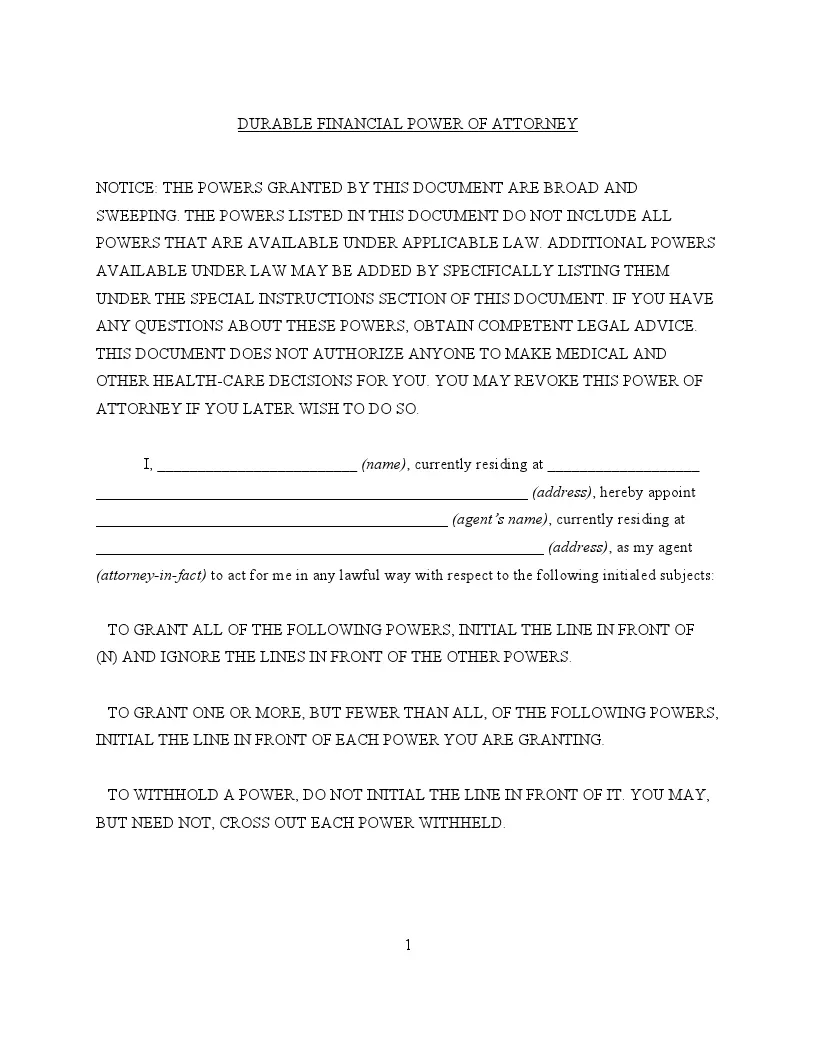
State-Specific Power of Attorney Templates by Type
Every competent adult that has the capacity to contract may prepare and sign a power of attorney. A power of attorney document should always include the principal’s and agent’s contact information, alternate agent’s contacts (if any), granted powers (following the type), and durability. The principal must sign the document in the presence of two witnesses or a notary public. All these requirements are applicable in all states. We’ve mentioned above how it is essential to prepare a state-specific form. That’s why we’ve prepared another list of state-specific POAs, but this time divided according to their types. If you know exactly what POA form you need, check the list of the lawyer-approved documents below.
- Durable Power of Attorney for Arizona
- Medical Power of Attorney for Arizona
- Durable Power of Attorney for California
- Durable Power of Attorney for Colorado
- Medical Power of Attorney for Colorado
- Durable Power of Attorney for Florida
- Medical Power of Attorney for Florida
- Georgia Durable Power of Attorney
- Georgia Medical Power of Attorney
- Idaho Medical Power of Attorney
- Durable Power of Attorney for Illinois
- Medical Power of Attorney for Illinois
- Durable Power of Attorney for Indiana
- Medical Power of Attorney for Indiana
- Durable Power of Attorney for Kansas
- Maine Medical Power of Attorney
- Maryland Durable Power of Attorney
- Maryland Medical Power of Attorney
- Durable Power of Attorney for Massachusetts
- Medical Power of Attorney for Massachusetts
- Durable Power of Attorney for Michigan
- Medical Power of Attorney for Michigan
- Medical Power of Attorney for Minnesota
- Durable Power of Attorney for Missouri
- Medical Power of Attorney for Missouri
- New Jersey Durable Power of Attorney
- Medical Power of Attorney for New Jersey
- Durable Power of Attorney for New York
- Medical Power of Attorney for New York
- Durable Power of Attorney for North Carolina
- Medical Power of Attorney Form for North Carolina
- Durable Power of Attorney for Ohio
- Medical Power of Attorney for Ohio
- Durable Power of Attorney for Oklahoma
- Durable Power of Attorney for Oregon
- Medical Power of Attorney for Oregon
- Durable Power of Attorney for Pennsylvania
- Medical Power of Attorney for Pennsylvania
- South Carolina Durable Power of Attorney
- South Carolina Health Care Power of Attorney
- Durable Power of Attorney for Tennessee
- Durable Power of Attorney for Texas
- Medical Power of Attorney for Texas
- Medical Power of Attorney for Utah
- Durable Power of Attorney for Virginia
- Virginia Medical Power of Attorney
- Durable Power of Attorney for Washington State
- Wisconsin Power of Attorney for Health Care
More About Us
Clients hire Howrey for the extraordinary depth and breadth of our advocacy capabilities within three principal areas of law – Antitrust, Intellectual Property and complex Commercial Litigation and Arbitration. We are the only firm, among the AmLaw 100 and the Global 50, with such concentration. Our clients benefit from the substantial expertise and comprehensive resources this focus provides.
One Global Firm
Howrey operates as one integrated law firm, regardless of geographic location. We bring our firm’s diverse, experienced and multidisciplinary talent to every client, wherever and whenever the need arises. Whether local, national or transnational, Howrey builds cohesive teams that deliver efficient, consistent, predictable and successful results.
Long-Term Successes
We can be judged by the clients we keep. Many current clients have remained with us for over half a century and numerous others – among the world’s largest global corporations – span decades. We believe in long-term, strategic, business-to-business relationships that yield consistent quality, control of overall costs, predictability of time horizons and results, client priority on firm resources, and the careful alignment of legal strategies with a client’s business and product goals.
Howrey Beliefs
We believe in providing exceptional client service. It is the basic foundation of the strong relationship we have with our clients. They depend upon us to be a strategic partner in their success.
We believe diversity is a powerful advantage. It is an integral part of our drive for excellence and our goal of providing the highest level of client service.
We believe that justice is for all. We have a rich and long-standing tradition of providing pro bono representation to those who might otherwise be denied access to legal services.
We believe that leadership comes with obligations. It is our obligation to improve the profession and to advance the efficiency and fairness of the legal systems in which we advocate for our clients.
The Business of Howrey
We know that our firm is a large, multi-faceted, growing, global business that requires planning, innovation and investment to keep pace with the complex disputes our clients face. We understand that sound business principles must also be applied to the large, demanding and costly litigations we manage. Innovative staffing, reliable budgeting and budget management, technology based support systems, and other value engineering techniques are all components of the Howrey case management strategy.
Howrey’s IP practice is frequently ranked at the top of client and peer surveys. Recent IP practice group accolades include:
Ranked #1 U.S. IP Firm in 2006 by Managing Intellectual Property.
Named Global Patent Law Firm of the Year 2005 by Who’s Who Legal.
A record fifteen Howrey patent lawyers were named in the 2005 “Patent Law Expert Guide,” a respected expert guide to the world’s leading patent practitioners. Howrey had more nominations than any other firm in the world.
Ranked #1 in the 2004 IP Law & Business “Who Protects IP America” survey of the largest and most influential intellectual property practices in the world, as rated by the general counsel of the Fortune 250.
Howrey IP #1 in the 2004 Corporate Counsel’s “Who Counsels Who,” a ranking of the Fortune 250’s primary outside counsel.
Howrey was recognized as the #1 U.S. Intellectual Property practice in 2004 by Chambers & Partners.
Howrey was named a finalist in the 2004 Litigation Department of the Year competition conducted by The American Lawyer’s Intellectual Property section.
A record eight Howrey trademark lawyers were named in the 2004 “Guide to the World’s Leading Trade Mark Law Practitioners,” a respected expert guide to the world’s leading trademark practitioners.
Howrey’s U.S. Intellectual Property practice was ranked fourth largest in size by Managing Intellectual Property’s (MIP) 2004 Biggest IP Firms survey.
Strength Through Diversity
At Howrey, we believe diversity matters. We recognize that diversity at all levels of our workforce and in all forms strengthens us as a firm. By building teams with diverse characteristics – be they ethnic, racial, gender, cultural, social, economic, physical, sexual orientation or otherwise – we cultivate diversity of ideas and innovation that benefits both our clients and our people. As one of our core values, our commitment to diversity is an integral part of our drive for excellence and dedication to providing the highest level of client service.
We demonstrate our dedication to diversity in principle and in practice. Howrey’s Diversity Committee serves as an integral part of the firm management and operational structure and acts on a firmwide basis to promote hiring, retention and career and business development opportunities for diverse attorneys in the firm. Our established diversity initiative promotes a work environment enabling all attorneys to contribute to the success of the firm and to achieve their full potential in service to our clients. Howrey’s Women’s Leadership Initiative, founded in 1992, actively promotes the advancement of professional women within the firm through mentoring, networking and career development.
Participation at All Levels of Firm Management
Diverse attorneys participate at all levels of firm management and in professional and business development activities, serving on Howrey’s Evaluation, Hiring, Attorney Development, Assignment, Professional Development, Pro Bono and Executive Committees, as well as holding other positions in firm governance and management, including practice group leadership.
Our Diversity Statement
Howrey values diversity as an asset that contributes to the firm’s competitive advantage. For Howrey, Diversity Management is not a legal requirement but rather a strategic business imperative.
Diversity refers to the full range of differences in which people differ from one another, including: race, gender, geographic origin, lifestyle, age, sexual orientation, physical and personality traits, tenure with the firm, and functional and educational backgrounds, etc., and in all ways that our workforce parallels the differences of the client base we serve.
Diversity Management means creating and sustaining an environment where no one will be given either unnatural advantage or disadvantage in any way in matters of hiring, promotion or assignment, and where every employee is able to make meaningful contributions and achieve his/her full potential and to use this potential to realize the firm’s vision.
It is the policy of Howrey to establish and maintain a workforce that is broadly representative of the diversity of our customers and to create and sustain an environment that enables all employees to contribute to the success of the firm and to achieve the full potential in service to our clients.
Each individual’s ability to progress will be determined by whether the individual is the best-qualified for a given opportunity. Each decision regarding Human Resources policies and practices affecting Howrey employees will be measured by this standard.
Howrey’s Equal Employment Opportunity (EEO) Statement
It is the policy of Howrey to provide equal employment opportunities without regard to race, color, sex/gender, sexual orientation, age, religion, national origin, citizenship status, physical and mental disability, and past, present and future service in the uniformed services of the United States. This policy also includes disabled and Vietnam-era veterans. It relates to all phases of employment, including but not limited to recruitment, benefits, compensation, disciplinary actions, layoffs and recalls from layoffs, leaves of absence, promotional opportunities, social and recreational programs, termination of employment, work environment, training and tuition assistance.
It is also the policy of Howrey to comply fully with all applicable state and local fair employment laws, which may forbid discrimination on the basis of other characteristics, such as marital status.
Our Practices
Global Litigation
With offices around the world, Howrey is well-positioned to serve our clients in any country, in any court and in any litigation matter.
The National Law Journal recognized Howrey’s “impressive track record” for “exemplary, cutting-edge” defense work and “positioning overseas for an impending globalized litigation culture.”
The Global Litigation practice focuses primarily in the areas of Commercial Litigation and Trial; Securities Litigation, Government Enforcement and White Collar Defense; Insurance Recovery; Construction; Environmental, Product and Tort Litigation; Consumer Litigation and Class Actions; Government Contracts; Appellate; and International Arbitration and Alternate Dispute Resolution.
By reviewing the scope of Howrey’s Global Litigation practice, including the backgrounds, accomplishments and experience of our individual attorneys, and the complexity of the cases we handle, the strength and breadth of our practice will come into focus.
Howrey attorneys are “In Court Every Day” not just litigating, but trying cases involving precedent-setting legal issues that affect individual clients, entire industries and global commerce. Howrey’s reputation for success in state and federal courts throughout the US, the European Court of Justice, the Court of First Instance and other jurisdictions around the world is rooted in our history of, and commitment to, trial readiness.
Our Global Litigation group’s proven ability to work seamlessly across all practice areas and global offices is a core strength. Our global strategies for international companies dealing in significant litigation matters around the world is a powerful advantage for Howrey clients.
Effective Results
Unlike most law firms, Howrey takes a “trial-ready” approach to matters. We believe that the best results come when our attorneys and clients prepare a case as if it were going to trial. This approach fosters a disciplined pretrial process focused on strategies that have a realistic chance of disposing of a case prior to trial, or of significantly narrowing and defining the issues for trial. Our trial-ready approach is a powerful bargaining chip with opponents; they know we are prepared to stand up in court and fight for our clients.
Global Capabilities
Trial experience in all 50 US states, more than 20 European countries, and many other regions around the world
National and International Counsel to Fortune 500 companies, managing litigation dockets across jurisdictions, and devising litigation strategies to protect clients’ long-term interests and objectives. Firmwide litigation focus and unrivaled litigation infrastructure supports our commitment to advancing our clients interests in court anywhere in the world.
An Intellectual Property Powerhouse
Howrey’s Intellectual Property (IP) practice is one of the most renowned in the world. Our commitment to protect and uphold IP rights spans nearly half a century and we are consistently regarded as one of the top go-to firms to handle IP matters in the United States and around the globe.
We stand apart because of our trial-tested abilities. This is the reason Howrey IP’s practice is consistently top ranked by industry watchers and retained by loyal clients.
Varied Industry Expertise
Howrey’s IP professionals include attorneys, patent agents and scientific advisors. We have the depth and breadth of legal and technical expertise to provide IP services of the highest quality. More than half of our IP practice group members hold a technical degree, many have a Ph.D. and a majority are registered with the US Patent and Trademark Office (USPTO).
Howrey’s IP attorneys and affiliated technical professionals draw upon an extensive database of knowledge and experience in advocating for clients across industries. We offer this talent as a strategic partner, preferred provider and panel counsel to Fortune 500 and Global 250 firms.
By reviewing the scope of Howrey’s IP practice, including the backgrounds—accomplishments and experience of our individual attorneys, and the complexity of the cases we handle—the strength and breadth of our practice will come into focus.
Services
Howrey’s IP practice offers a comprehensive range of services for litigation, prosecution and counseling, including:
Litigation
- Patent Litigation
- Trademark Litigation
- Section 337 before the US International Trade Commission (ITC)
- Trade Secret Litigation
- Copyright Litigation
- Trade Dress Litigation
Prosecution
- Patent Prosecution
- Trademark Prosecution
- Counseling
- Licensing, Counseling and Related Matters
- Patent Interference, Opposition and Cancellation Proceedings
- Patent Portfolio Utilization/Enhancement
- Trademark Portfolio Brand Development, Search and Clearance
- Client Focus
Howrey’s global Intellectual Property practice is fluent in the languages of technology, science and business. The firm’s size, focused scope of practice and highly developed IP-centric support infrastructure enable Howrey to achieve significant economies of scale, often resulting in even greater cost-savings to clients than they expect from a firm of our caliber.
A Leader in Antitrust
For more than 50 years, Howrey has represented the world’s leading companies in precedent-setting matters. As their ally and champion, clients hire Howrey to protect their interests in negotiations and courtrooms around the world.
Clients facing the prospect of a contested merger or an antitrust matter rely on Howrey for our antitrust knowledge and outstanding litigation record. Our clients know they get the full benefits of our depth and breadth of experience, thought leadership and reputation at trial or administrative proceedings.
By reviewing the scope of Howrey’s Antitrust practice, including the backgrounds, accomplishments and experience of our individual attorneys and the complexity of the cases we handle, the strength and breadth of our practice will come into focus.
Scope of Experience
Howrey currently represents parties in one-third of all pending private US antitrust multidistrict litigation. Over the last ten years, Howrey attorneys have served as trial counsel on about 40 percent of all civil antitrust cases brought to trial by the US Department of Justice and Federal Trade Commission.
Worldwide, Howrey is one of the few law firms prepared to assist companies with multijurisdictional merger, antitrust or cartel investigations. With a significant global presence – including the world’s antitrust capitals – Howrey is well-positioned and ready to handle the toughest and most complex antitrust matters as they arise.